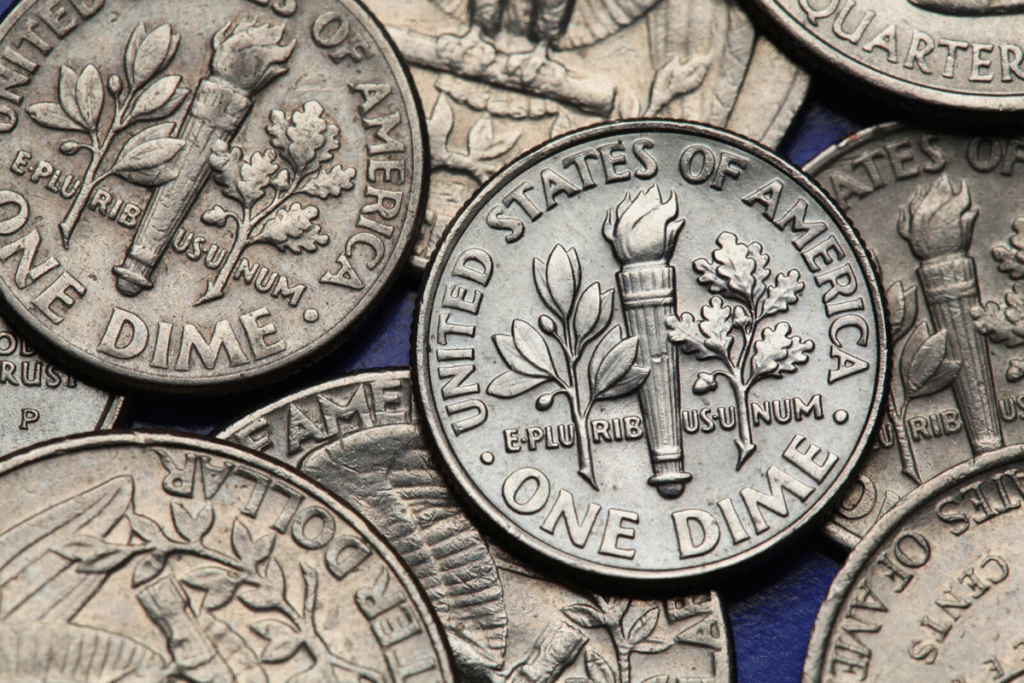
The Mercury dime, minted from 1916 to 1945, is one of the most iconic coins in U.S. history. While many of these dimes remain common, a few rare versions have skyrocketed in value due to minting errors, low mintage numbers, or unique characteristics. Some Mercury dimes have sold for tens or even hundreds of thousands of dollars at auction. Here are three rare Mercury dimes that are worth checking your change jar for—one of them could make you a small fortune!
1916-D Mercury Dime
The 1916-D is one of the most sought-after Mercury dimes in existence. It was struck in Denver with a total mintage of only 264,000 coins, making it the lowest production year of the entire Mercury dime series. This coin is easily identified by the “D” mint mark on the reverse side near the bottom left of the torch. In good condition, this dime can bring in $1,000 to $15,000, while uncirculated examples have sold for over $200,000 at auction. Its combination of rarity and historical significance makes it a collector favorite.
1942/1 Mercury Dime (Overdate Error)
This error coin is the result of a 1942 die being struck over a 1941 die, creating a double date error that’s clearly visible with magnification. There are two known versions: the 1942/1 from the Philadelphia Mint and the 1942/1-D from the Denver Mint. Both are considered extremely valuable, with clean examples selling for $2,000 to $15,000, and high-grade specimens going for $50,000 or more. These dimes were created by mistake, but their error status makes them highly collectible today.
1921 Mercury Dime (Philadelphia and Denver)
Both the 1921 and 1921-D Mercury dimes are rare due to low mintages during the post-World War I recession. The Philadelphia Mint produced just 1.2 million, while Denver made only 1.08 million. These coins can sell for $100 to $500 in worn condition, but uncirculated versions easily top $10,000. Because these coins were heavily circulated, finding one in great condition is rare, which adds to their value in the collector market.
Most Mercury dimes are only worth their face value, but a few exceptional examples—like the 1916-D, the 1942/1 overdate, and the low-mintage 1921 issues—can be worth thousands or more. If you have a stash of old coins or a collection passed down through your family, it’s worth examining each Mercury dime closely. You might be holding one of these rare treasures without even realizing it.
FAQ’s:
1. How can I tell if I have a 1916-D Mercury dime?
Check the reverse (back) of the coin, near the bottom-left of the torch. If there’s a small “D” mint mark, and the date is 1916, it could be valuable.
2. What is an overdate error?
An overdate error happens when a coin die from one year is repunched with a new date but still shows signs of the original date underneath. The 1942/1 Mercury dime is a classic example.
3. How do I check the value of my Mercury dime?
You can compare it to listings in coin value guides, but the best way is to have it professionally graded by PCGS or NGC.
4. Are all 1921 Mercury dimes valuable?
Yes, especially if they’re in good condition. Lower grades may still sell for hundreds, while higher grades can go into the thousands.
5. Where can I sell a valuable Mercury dime?
You can sell rare dimes through coin dealers, auctions, or online marketplaces like eBay, but always verify the buyer’s credibility first.